Win epic final against New Zealand on boundaries after the match and Super Over tied; Kiwi captain Williamson named Player of the Tournament
Martin Guptill played a full ball on leg stump from Jofra Archer to deep midwicket. Two runs were needed off the last ball of the Super Over and he put in a desperate dive — the second fateful one in less than half an hour — to complete the second, but there was too much ground between his bat and the World Cup trophy calling to him from just beyond the crease. Jos Buttler gathered the throw, which was well wide of the stumps, but there was enough time to whip the bails off, which he did and started running towards the gallery in ecstasy, followed by his teammates and fuelled by possibly the loudest roar ever heard at Lord’s.
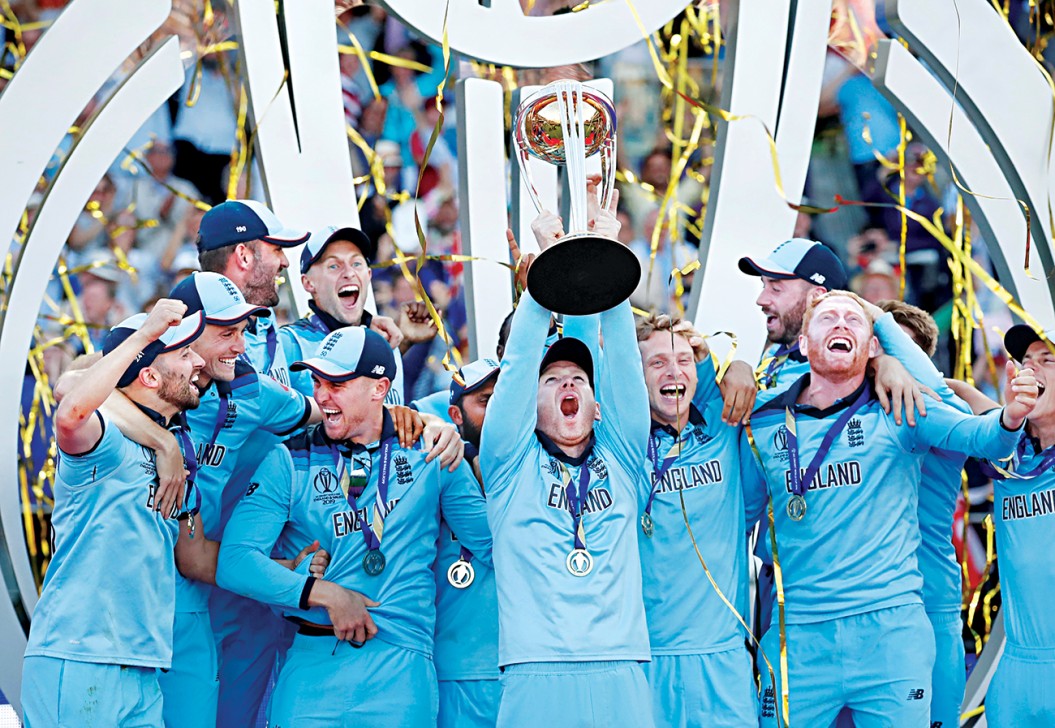
England had won their first ever World Cup, had won it at home — the third successive home victory in World Cups after India’s in 2011 and Australia’s in 2015.
But runs could not separate New Zealand and England in the greatest World Cup final yesterday, even though the teams had two chances to get ahead. The match saw two ties — one in normal play and one in the Super Over. Buttler celebrated immediately because he knew that England, having hit more boundaries — 22 fours and two sixes to New Zealand’s 14 fours and two sixes — in the 50-over portion, had edged the tie-breaker to a tie-breaker.
England had sent Jos Buttler and Ben Stokes — the man who made the Super Over possible with his last-over heroics — and the duo hit two boundaries while scoring 15 runs off Trent Boult, who nearly defended 14 runs in the last over of normal time.
The pacey Jofra Archer came in to bowl for England and New Zealand had nominated Jimmy Neesham and Guptill to score the 16 runs that would give them their first World Cup. Archer started with a wide, conceded two the next ball and Neesham hammered a six off the third ball. With seven required off four balls Neesham scampered a pair of doubles before getting just a single off the penultimate ball. That set the stage for the last ball, after which there was heartbreak for New Zealand and elation for most of the 30,000 gathered at Lord’s.
Before the high-octane two-over finish, there was a pulsating 100-over contest that led up to that point. New Zealand bowled brilliantly to defend 241 for eight, and England’s Ben Stokes hit a nearly perfectly-paced 98-ball 84 to take England level after they were at one stage 86 for four.
It was nearly perfectly paced because he needed fortune to end up as the player-of-the-match. There was another despairing dive before Guptill’s, this one during the last over of normal play when England needed nine runs from three balls. Stokes, having just hit a six after playing two dot balls from Trent Boult, whipped a ball away to deep midwicket and dove to beat the throw — from none other than Guptill — and the ball deflected off the bat and ran away for four. That effectively brought six runs from the fourth ball. With three more required from the last two balls, Adil Rashid was run out at the non-striker’s end after Stokes had hit to long off. With two more needed off the last ball, last man Mark Wood was run out trying to take the match-winning second, bringing on the Super Over in a World Cup final that will go down in folklore as one of the greatest matches — let alone World Cup finals — ever played.
Before that, Buttler and Stokes had put on 110 runs for the fifth wicket to fish England out of trouble. Buttler was the dominant partner, scoring 59 off 60 balls. When the last 10 overs started England needed 72 runs with Buttler and Stokes at the crease. But that is when the Kiwis started turning it around as Jimmy Neesham and Lockie Ferguson bowled to their fields and dried up the boundaries. Buttler departed in the 45th over with 45 still left to win, caught in the deep off Ferguson trying to re-lease the pressure. Chris Woakes departed for 10 in the 47th over, caught behind off a fiery Ferguson. England needed 24 off the last two overs. Liam Plunkett holed out off Jimmy Neesham, caught at long off by Boult. In another stroke of luck for Stokes, Boult nearly pulled off a stunner off the fourth ball of the over when he caught the ball at the boundary, but his feet had touched the ropes before he could throw it back for a combination catch. Neesham then accounted for Jofra Archer, bowling him for a first-ball duck with a slower ball. With two wickets left and 15 runs to get, it seemed New Zealand’s match, but that is when the match turned from a classic to a thriller of epic proportions.
Earlier, the crunch battle was England’s belligerent opening pair of Jason Roy and Jonny Bairstow taking on New Zealand’s incisive new-ball duo of Trent Boult and Matt Henry.
The left-handed Boult almost accounted for Roy in the very first ball of the innings, rapping the right-hander with a sharp inswinger that seemed headed for the stumps. New Zealand reviewed the not-out decision, but the decision stayed with the umpire as just a part of the ball was hitting leg stump.
While New Zealand brought Test-match ethos by trying for wickets with early movement, Roy repre-sented England’s limited-overs motto by going hard at anything that was slightly off line or length. He hit three boundaries in that process, but Henry also had him playing and missing on numerous occasions with perfectly pitched outswingers. Eventually, Roy got close enough to one of those and edged through to the keeper in the sixth over with the score on 28.
If New Zealand’s bowling was in Test-match mode, their fielding was very much of the cutting-edge limited-overs variety, scampering after every ball and throwing themselves at every ball to support Boult, Henry, the pacey Lockie Ferguson and the variety-laden Colin de Grandhomme. Roy’s dismissal saw just 31 runs in the next 65 balls and it was the pressure built up through that concerted effort that induced Joe Root to go for an airy drive and edge behind to the keeper in the 17th over off de Grandhomme.
Bairstow departed next when he played on to a fast Ferguson lifter in the 20th over with the score reading 71 for three and the required run rate nudging six an over. That set the stage for New Zealand’s comparative weak link of Jimmy Neesham to come on and England skipper Eoin Morgan, perhaps trying to release the pressure, went early at a long hop off the first delivery and Ferguson took a superb catch running in from deep point and diving forward to send Morgan on his way.
Earlier still, ages ago it seemed by the end of the match, New Zealand were restricted to 241 for eight by a strong bowling performance from England. Liam Plunkett took three for 42 and Chris Woakes three for 37 as England successfully managed to deny New Zealand’s danger men Kane Williamson and Ross Taylor meaningful contributions, which they had done throughout the World Cup. Opener Henry Nicholls top-scored with 55. Even after Taylor and Williamson’s departures, New Zealand played within their means and concentrated on getting just enough runs on the board to put pressure on England in the biggest match of their lives in front of a partisan crowd. They put faith in their bowling lineup to dial up that pressure, and that is exactly what they did.
At the end, however, England proved equal to the task and their boundary count, and a stray deflection, saw them crowned champions at home.
The Fourth of
July—also known as Independence Day or July 4th—has been a federal holiday in
the United States since 1941, but the tradition of Independence Day celebrations
goes back to the 18th century and the American Revolution. On July 2nd, 1776,
the Continental Congress voted in favor of independence, and two days later
delegates from the 13 colonies adopted the Declaration of Independence, a
historic document drafted by former us president Thomas Jefferson. From 1776 to
the present day, July 4th has been celebrated as the birth of American
independence, with festivities ranging from fireworks, parades and concerts to
more casual family gatherings and barbecues.
History of American Independence
When the initial battles in the Revolutionary
War broke out in April 1775, few colonists desired complete independence
from Great Britain, and those who did were considered radical.
By the middle of the following year, however, many
more colonists had come to favor independence, thanks to growing hostility
against Britain and the spread of revolutionary sentiments such as those
expressed in the bestselling pamphlet “Common Sense,” published by Thomas
Paine in early 1776.
On June 7, when the Continental
Congress met at the Pennsylvania State House (later Independence
Hall) in Philadelphia, the Virginia delegate Richard Henry Lee
introduced a motion calling for the colonies’ independence.
Amid heated
debate, Congress postponed the vote on Lee’s resolution, but appointed a
five-man committee—including Thomas Jefferson of Virginia, John
Adams of Massachusetts, Roger Sherman
of Connecticut, Benjamin Franklin of Pennsylvania and Robert R.
Livingston of New York—to draft a formal statement justifying the break
with Great Britain.
On July 2nd, the Continental Congress voted in favor
of Lee’s resolution for independence in a near-unanimous vote (the New York
delegation abstained, but later voted affirmatively). On that day, John Adams
wrote to his wife Abigail that July 2 “will be celebrated, by succeeding
Generations, as the great anniversary Festival” and that the celebration should
include “Pomp and Parade…Games, Sports, Guns, Bells, Bonfires and Illuminations
from one End of this Continent to the other.”
On July 4th, the Continental Congress formally
adopted the Declaration of Independence, which had been written largely by Jefferson.
Though the vote for actual independence took place on July 2nd, from then on
the 4th became the day that was celebrated as the birth of American
independence.
Early Fourth of July Celebrations
In the pre-Revolutionary years, colonists had held
annual celebrations of the king’s birthday, which traditionally included the
ringing of bells, bonfires, processions and speechmaking. By contrast, during
the summer of 1776 some colonists celebrated the birth of independence by
holding mock funerals for King George III, as a way of symbolizing the end
of the monarchy’s hold on America and the triumph of liberty.
Festivities including concerts, bonfires, parades
and the firing of cannons and muskets usually accompanied the first public
readings of the Declaration of Independence, beginning immediately after its
adoption. Philadelphia held the first annual commemoration of independence on
July 4, 1777, while Congress was still occupied with the ongoing war.
George Washington issued double rations of rum to all his soldiers to
mark the anniversary of independence in 1778, and in 1781, several months
before the key American victory at Yorktown, Massachusetts became the first
state to make July 4th an official state holiday.
After the Revolutionary War,
Americans continued to commemorate Independence Day every year, in celebrations
that allowed the new nation’s emerging political leaders to address citizens
and create a feeling of unity. By the last decade of the 18th century, the two
major political parties—the Federalist Party and
Democratic-Republicans—that had arisen began holding separate Fourth of July
celebrations in many large cities.
Fourth of July Becomes a Federal Holiday
The tradition of patriotic celebration became even
more widespread after the War of 1812, in which the United States again
faced Great Britain. In 1870, the U.S. Congress made July 4th a federal
holiday; in 1941, the provision was expanded to grant a paid holiday to all
federal employees.
Over the years, the political importance of the
holiday would decline, but Independence Day remained an important national
holiday and a symbol of patriotism.
Falling in mid-summer, the Fourth of July has since
the late 19th century become a major focus of leisure activities and a common
occasion for family get-togethers, often involving fireworks and outdoor
barbecues. The most common symbol of the holiday is the American flag, and a
common musical accompaniment is “The Star-Spangled Banner,” the national anthem
of the United States.
Would we be healthier? Would the planet? The risks and
benefits of a meat-free life By Richard Corliss
Photo Illustration for TIME by Aaron Goodman
FIVE REASONS TO EAT MEAT:
1) It tastes
good
2) It makes
you feel tradition
3) It
supports the American Tradition
4) It
supports the nation’s farmers
5) Your
parents did it
Oh, sorry … those are five reasons to smoke cigarettes.
Meat is more complicated. It’s a food most Americans eat virtually every day.
at the dinner table; in the cafeteria; on the barbecue patio; with mustard at a
ballpark; or, a billion times a year, with special sauce, lettuce, cheese,
pickles, onions on a sesame-seed bun. Beef is, the TV commercials say,
“America’s Food”- the stars and Stripes served up medium rare-and as entwined
with the nation’s nation of its robust frontier heritage as, well, the Marlboro
man.
But these days America’s cowboys seem a bit small in the
saddle. Those cattle they round up have become politically incorrect: for many,
meat is an obscene cuisine. It’s not just the additives and ailments connected
dish of hormones, E coli bacteria or the scary specter of mad-cow disease might
be effective enough as an appetite suppressant. It’s that more and more American’s
particularly young Americans, have started engaging in a practice that would
once have shocked their parents. They are eating their vegetables. Also their
grains and sprouts. Some 10 million Americans today consider themselves to be
practicing vegetarians, according to a Time poll of 10,000 adults; an
additional 20 million have flirted with vegetarianism sometime in their past.
To get a taste of the cowboy’s ancient pride, and current
defensiveness, just click on South Dakota cattleman Jody Brown’s website,
www.ranchers.net , and read the new meat mantras: `Vegetarians don’t live
longer, they just look older”, and “If animals weren’t meat to be eaten, than
why are they made out of meat?” (One might ask the same of human.) For Brown
and his generation of unquestioning meat eaters, dinner is something the
parents put on the table and the kids put in their bodies. Of his own kids, he
says, “We expect them to eat a little of everything.” So beef is served nearly
every night at the Brown homestead, with nary a squawk from Jeff, 17, Luke, 13,
and Hannah, 11, But Jody admits to at least one liberal sympathy. “If a
Vegetarian got a flat tire in my community,” he says, “I’d come out and help
him.”
For the rancher who makes his living with meat or the
vegetarian whose diet could someday drive all those breeder slaughterers to
bankruptcy, nothing is simple any more. Gone is the age of American innocence,
or naiveté, when such items as haircuts and handshakes, family names and school
uniforms, farms and zoos, cowboys and ranchers, had no particular political
meaning. Now everything is up for rancorous debate. And no aspect of our daily
lives- our lives as food consumers-gets more heat than meat.
For millions of vegetarians, beef is a four-letter word;
veal summons charnel visions of infanticide. Many children, raised on hit films
like Babe and Chicken Run, Recoil from eating their movie heroes and switch to
what the meat defeaters like to call a “nonviolent diet.” Vegetarianism
resolves a conscientious person’s inner turf war by providing an edible complex
of good-deed-doing; to go veggie is to be more humane. Give up meat, and save
lives!
Of course, one of the lives you could save or at least prolong
is your own. For vegetarianism should be about more than not eating; it’s also
about smart eating. You needn’t be a born-again foodist to think this. The
American Dietetic Association, a pretty centrist group, has proclaimed that
“appropriately planned vegetarian diets are healthful, are nutritionally
adequate and provide health benefits in the prevention and treatment of certain
diseases.
So, how about it? Should we all become vegetarians? Not just
teens but also infants, oldsters, athletes-everyone? Will it help us live
longer, healthier lives? Does it work for people of every age and level of work
activity? Can we find the right vegetarian diet and stick to it? And if we can
do it, will we?
THERE ARE MANY REASONS TO TRY VEG Etarianism as there are
soft-eyed cows and soft-hearted kids. To impressionable young minds,
vegetarianism can sound sensible, ethical and- as nearly 25% of adolescents
polled by Teenage Research Unlimited said- “cool.” College students think so
too. A study conducted by Arizona State University psychology professors
Richard Stein and Carol Nemeroff reported that, sight unseen, salad eaters were
rated more moral, virtuous and considerate than steak eaters. “A century ago, a
high-meat diet was thought to be health-favorable,” says Paul Rozin of the
University of Pennsylvania. “Kids today are the first generation to live in a
culture where vegetarianism is common, where it is publicly promoted on health
and ecological grounds.” And Kids, as any parent can tell you, spur the
consumer economy; that explains in part the burgeoning sales of veggie burgers
(soy, bulgur wheat, cooked rice, mushrooms, onions and flavoring in Big Mac
drag) in supermarkets and fast-food chains.
Children, who are signing on to vegetarianism much faster
than adults, may be educating their parents. Vegetarian food sales are savoring
double-digit growth. Top restaurants have added more meatless dishes. Trendy
“living foods” or “raw” restaurants are sprouting up, like Roxanne’s in
Larkspur, California, where no meat, fish, poultry or dairy items are served,
and nothing is cooked to temperatures in excess of 48“Going
to my restaurant,” says Roxanne Klein, “is like going to a really cool new
country you haven’t experienced before.”
Like any country, vegetarianism has its hidden complexities.
For one thing, vegetarians come in more than half a dozen flavors, from
sproutarians to pesco-pollo vegetarians. The most notorious are the vegan
(rhymes with intriguing’ or fatiguing’) vegetarians. The Green party of the
movement, vegans decline to consumer, use or wear and animal products. They
also avoid honey, since its productions demands the oppression of worker bees.
TV’s favorite vegetarian, the cartoon 8-years-old Lisa Simpson, once had c
crush on a fellow who described himself as “a Level Five vegan-I don’t eat
anything that casts a shadow.” Among vegan celebrities: the rock star Moby and
Ohio Congressman Dennis Kucinich, who swore off steak for breakfast and insists
he feels much better starting his day with miso soup, brown rice or oat groats.
To true believers-who refrain from meat as an A.A. member
does from drink and do a spit-take ot told that there’s gelatin in their soup-a
semi vegetarian is no vegetarian at all. A phrase like pesco-pollo- vegetarian,
to them, is an oxymoron, like “lapsed Catholic” or “semivirgin.” vegetation
Times, the bible of this particular congregation, lays down the dogma: “For
many people who are working to become vegetarians, chicken and fish may be
transitional foods, but they are not vegetarian foods … the word ‘vegetarian’
means someone who eats no meat, fish or chicken.”
Clear enough? No to many Americans. In a survey of 11,000
individuals, 37% of those who responded “Yes, I am vegetarian” also reported
that in the previous 24 hours they had eaten red meat, 60% had eaten meat,
poultry or seafood. Perhaps those surveyed thought a vegetarian is someone who,
from time to time, eats vegetables as a side dish-say, alongside a prime rib.
Of more than one-third of people in a large sample don’t know the broadest
definition of vegetarian, one wonders how they can be trusted with something
much more difficult: the full-time care and picky-picky feeding of their
bodies, whatever their dietary preferences.
We know that fruits, vegetables, grains, legumes and nuts
are healthy. There are any number of students that show that consuming more of
these plant-based foods reduces the risk for a long list of chronic maladies
(including coronary artery disease, obesity, diabetes and many cancers) and is
a probable factor in increased longevity in the industrialized world. We know
that on average we eat too few fruits and vegetables and too much saturated
fat, of which meat and dairy are prime contributions. We also know that in the
real world, real diets vegetarian and non-vegetarian-as consumed by real people
range from primly virtuous to pig-out voracious. There are meat eaters who eat
more and batter vegetables than vegetarians, and vegetarians who eat more
artery clogging fats than meat eaters.
The International Congress on vegetarian Nutrition, a major
conference on the subject, was held earlier this year at Loma Linda
(California) University. The research presented their included some encouraging
if tentative findings: that a predominantly vegetarian diet may have beneficial
effects for kidney and nerve function in diabetics, as well as for weight loss;
that eating more fruits and vegetables can slow, and perhaps reverse,
age-related declines in brain function and in cognitive and motor
performance-at least in rats; that vegetarian seniors have a lower death rate
and use less medication than meat-eating seniors; that vegetarians have a
healthier total intake of fats and cholesterol but a less health intake of
fatty acids (such as the heart-protecting omega-3 fatty acids found in fish
oil).
But one paper suggested that low protein diets (associated
with vegetarians) reduce calcium absorption and may have a negative impact on
skeletal health. And although several studies on Seventh-Day Adventists
(typically vegetarians) indicated that they have a longer-than-average life
expectancy, other studies found that prostate cancer rates were high in
Adventists, and one study found Adventists were more likely to suffer hip
fractures.
Can it be that vegetarianism is bad for your health? That’s
a complex issue. There’s a big, beautiful plant kingdom out there; you ought to
be able to dine healthily on this botanical bounty, with perfect knowledge, you
can indeed eat like a king from the vegetable world. But ordinary people are not
nutrition professionals. While some vegetarians have the full skinny on how to
watch their riboflavin and vitamins D and B12 many more haven’t a clue. This is
one reason that vegetarians, in a study of overall nutrition, scored
significantly lower than non-vegetarians on the USDA’s Healthily Eating Index,
which compares actual diet with USDA guidelines.
Another reason is that vegans skew the stats, because their
strict avoidance of meat, eggs and dairy products can lead to deficiencies in
iron, calcium and vitamin B12. “These nutrients are the problem,” says Johanna
Dwyer, a professor of nutrition and medicine at Tufts University. “At least
among the vegans who are also philosophically opposed to fortified foods and/or
vitamin and mineral supplements”
Debates about the efficacy of vegetarianism follow us from
cradle to wheelchair. In 1998 child-care expert Dr. Benjamin Spock, who became
a vegetarian late in life, stoked a stir by recommending that children over the
age of 2 be raised as vegans, rejecting even milk and eggs. The American
Dietetic Association says it is possible to raise kids as vegans but cautions
that special care must be taken with nursing infants (who don’t develop
properly without the nutrients in mother’s milk or fortified formula). Other
researchers warn that infants breast-fed by vegans have lower levels of vitamin
B12 and DHA (an omega-3 fatty acid), important to vision and growth.
And there is always the chance of vegetarianism gone madly
wrong. A queen’s New York, couple was indicted last May for first-degree
assault, charged with nearly starving their toddler to death on a strict diet
of juices, ground nuts, herbal tea, beans, flaxseed and cod-liver oils. At 16
months the girl weight 4.5 kg, less than half the normal of a child her age.
Their lawyer’s defense: “They felt that they have their own lifestyle. They’re
vegetarians. The couple declined to plea-bargain, and are still in jail
awaiting trial.
Many children decide in their own to become vegetarians and
are declaring their preference at ever more precious ages; its often their
first act of domestic rebellion. But a youngster is at a disadvantage insisting
on a rigorous cuisine before he or she can cook food-or buy it or even read-and
when the one whose menu is challenged is the parent: nurturer, disciplinarian
and executive chef. Alicia Hurtado of Oak Park, Illinois, has been a vegetarian
half her life-she’s 8 now-and mother Cheryle mostly indulges her daughter’s
diet. Still, Mom occasionally sneaks a little chicken broth into Alicia’s,”
Cheryle says, “I’ll be out of luck.”
By adolescence, kids can read the labels but often ignore
the ingredients. Research show that calcium intake is often insufficient in
American teens. By contrast, lactoovo teens usually have abundant calcium intake.
For vegans, however, consuming adequate amounts of calcium without the use of
fortified foods or supplements is difficult without careful dietary planning.
Among vegan youth who do not take supplements, there is reason for concern with
respect to iron, calcium, vitamins D and B12 and perhaps also selenium and
iodine.\
For four years Christina Economos has run the Tufts
longitudinal health study on young adults, a comprehensive survey of lifestyle
habits among undergraduates. In general, she finds that “kids who were most
influenced by family diet and health values are eating healthy vegetarian or
low-meat diets. But there is a whole group of students who decide to become
vegetarians and do it in a poor way. The ones who do it badly don’t know to navigate
in the vegetarian world. They eat more bread, cheese and pastry products and
load up on salad dressing. Their saturated-fat intake in no lower than red-meat
eaters, and they are more likely to consume inadequate amounts of vitamin B12
and protein. They may think they healthier because they are some sort of
vegetarian and they don’t eat red meat, but in fact they may be less healthy.
Jenny Woodson, 20, now a junior at Duke, has been a
vegetarian from way back. At 6, on a trip to Mcdonald’s, she or dered a tossed
salad. When Jenny lived in a dorm at high school, she quickly realized that
teens do not live on French fries and broccolio alone. “We ended up making
vegetarian sandwich with bagels and ingredients from the salad bar, cheese
fries and stuffed baked potatoes with cottage cheese.” Jenny and her friends
were careful to avoid high-fat, calorie-laden fare at the salad bar, but for
those who don’t exercise restraint, salad-bar fixings can become vegetarian
junk food.
Maggie Ellinger-Locke, 19, of the St. Louis, Mossouri,
suburb of University City, has been a vegetarian for eight years and went vegan
at 15. Since then she has not worn leather or wool products or slept under a
down comforter. She has not is used cups or utensils that have touched meat. “It
felt like we were keeping kosher,” says Maggie’s mother Linda, who isn’t
Jewish. At high school Maggie was ridiculed, even shoved to the ground, by teen
boys who apparently found her eating habits threatening. She is now enrolled at
Antioch College, where she majors in ecofeminism. “Here,” she says, “the people
on the defensive are the ones who eat meat.”
Maggie hit a few potholes on the road to perfection. Until
recently, she smoked up to two packs of cigarettes a day. (Cigarettes, after
all, are plants fortified with nicotine), quitting only because she didn’t want
to support the tobacco business. And she freely admits to an eating disorder:
for the past year she has been bulimic, bingeing and vomiting sometimes as much
as one a day to cope with stress. But she insists she is true to her beliefs:
even when bingeing, she remains dedicated to vegan consumption.
The American Dietetic Association found that vegetarian
diets are slightly more common among adolescents with eating problems but that
“recent data suggest that adopting a vegetarian diet does not lead to eating
disorders.” It can be argued that most American teens already have an eating
disorder- fast food; soft drinks and candy are a blueprint for obesity and
heart trouble. Why should teens be expected to purge their bad habits just
because they have gone veggie? Still, claims Simon Chaitowits of the pro
vegetarian and animal-rights group physicians Committee for Responsible
Medicine, “Kids are better off being just-food vegetarians than junk-food meat
eaters.
Maybe, According to Dr. Joan Sabate, Chairman of the Loma
Linda nutrition conference, there are still concern over vegetarian diets for
growing kids or lactating women. When you are in what he calls “a state of high
metabolic demand,” any diet that excludes food makes it harder to meet nutrient
requirements. But he is quick to add that “for the average sedentary adult
living in a Western society, a vegetarian diet meets dietary needs and prevents
chronic diseases better than an omnivore diet.”
Like kids and nursing moms, athletes need to be especially
smart eaters. Their success depends on bursts of energy. Sustained strength and
muscle mass, factors that require nutrients more easily obtained from meat. For
this reason, relative few top athletes are vegetarians. Besides, says sports
nutritionist Suzanne Girard Eberle, the author of Endurance Sports Nutrition,
“lots of athletes have no idea how their bodies work that’s why fad diets and
supplements are so attractive to them.”
Eberle notes that vegetarian diets done correctly are high
in fiber and low in fat. “But where are the calories?” she asks. “World-class
endurance athletes need in excess of 5,000 or 6,000 calories a day. Competition
can easily consume 10,000. You need to eat a lot of plant-based food to get
those calories. Being a vegetarian athlete is hard, really hard to do right?”
It’s not that easy for the rest of America, either.
Middle-aged to elderly adults can also develop deficiencies in a vegetarian
diet (as they can, of course, with a poor diet that includes meat).
Deficiencies in vitamins D and B12 and in iodine, which can lead to goiter, are
common. The elderly tend to compensate by taking supplements, but that approach
carries risks. Researchers have found cases in which vegetarian oldsters, who
are susceptible to iodine deficiency, had dangerously high and potentially
toxic levels of iodine in their bodies because they overdid the supplements.
Meat producers acknowledge that vegetarian diets can be
healthy. They also have responded to the call for leaner food; the National
Pork Board says that, compared with 20 years ago, Pork is on average 31% lower
in fat and 29% lower in saturated fat, and has 14% fewer calories and 10% less
cholesterol. But the defenders of meat and dairy can also go on the offensive.
They mention the need for B12. And then they ratchet up the fear factor. Kurt
Graetzer, CEO of the milk processor Education program, scans the drop in milk
consumption (not only by vegans but by kids who prefer soda, Snapple and Fruitopia)
and declares, “We are virtually developing a generation of osteoporotic
children.”
Dr. Michelle Warren, a professor of medicine at New York
Presbyterian Medical Center in New York City- and a member of the Council for Women’s Nutrition Solutions, which
is sponsored by the National Cattlemen’s Beef Association-expresses concern
about calcium deficiency connected with a vegan diet: “the most serious
consequence are low bone mass and osteoporosis. That is a permanent condition.”
Warren says that in her practices, she has seen young vegetarians with
irregular periods and loss of hair. “And there’s a peculiar color, a yellow
tinge to the skin,” that occurs in people who eat a lot of vegetables rich in
beta carotene in combination with a low-calorie diet. “I think it’s very
unattractive.” She also is troubled by the reasons some young vegetarians give
for their choice of diet. One female patient, Warren says, wouldn’t eat meat
because she was told it was the reason her father had a heart attack.
Michael Jacobson, executive director of the Centre for
Science in the public Interest in Washington, sees most of the meat and dairy
lobby’s arguments as desperate, disingenuous scare stories. “It unmasks the
industry’s self-interest,” he says, when it voices concern about B12 while
hundreds of thousands of people are dying prematurely because of too much
saturated fat from meat and dairy products.” Indeed, according to David
Pimentel, a Cornell ecologist, the average American consumes 112 grams of
protein a day, twice the amount recommended by the National Academy of
Sciences. “This has implications for cancer risks and stress on the urinary
system.” says Pimentel. “And with this protein comes a lot of fat. Fully 40% of
our calories-and heavy cardiovascular risks-come from fat.”
Pimentel argues that vegetarianism is much more
environment-friendly than diets revolving around meat. “In terms of calories
content, the grain consumed by American livestock could feed 800 million
people-and, if exported, would boost the U.S. trade balance by $80 billion a
year.” Grain-fed livestock consume 100,000 liters of water for every kilogram
of food they produce, compared with 2,000 liters for soybeans. Animal protein
also demands tremendous expenditures of fossil-fuel energy-eight times as much as
for a comparable amount of plant protein. Put another way, says Pimentel, the
average omnivore diet burns the equivalent of 4 L of gas a day-twice what it
takes to produce a vegan diet. And the U.S. Livestock population-cattle,
chickens, turkeys, lambs, pigs and the as U.S human population. But then there
are 7 billion of them, they outnumber us 25 to 1.
In the spirit of fair play to cowboy Jody Brown and his
endangered breed, let’s entertain two arguments in favor of eating meat. One is
that it made us human. “We would never have evolved as large, socially active
hominids if we hadn’t turned to meat,” says Katharine Milton, an anthropologist
at the University of California, Berkeley. The vegetarian primates (orangutans
and gorillas) are less social than the more omnivorous chimpanzees, possibly
because collecting and consuming all that forage takes so darned much time. The
early hominids took a bold leap: 2.5 million years ago, they were cracking
animal bones to eat the marrow. They ate the protein rich muscle tissue, says
Milton, “but also the rest of the animal-liver, marrow, brains-with their high
concentrations of other nutrients. Evolving humans ate it all.”
Just as important, they knew why they were eating it. In
Milton’s elegant phrase, “Solving dietary problems with your head is the
trajectory of the primate order.” Hominids grew big on meat, and smart on that
lovely brain-feeder, glucose, which they got from fruit, roots and tubers. This
diet of meat and glucose gave early man energy to burn-or rather, energy to
play house, to sing and socialize, to make culture, art, war. And finally,
about 10,000 years ago, to master agriculture and trade-which provided the
sophisticated system that modern humans can use to go vegetarian.
The other reason for beef eating is, hold on, ethical- a
matter of animal rights. The familiar argument for vegetarianism, articulated
by Tom Regan, a philosophical founder of the modern animal-rights movement, is
that it would save Babe the pig and Chicken Run’s Ginger from execution. But
what about Bugs Bunny and Mickey Mouse? Asks Steven Davis, Professor of animal
science at Oregon State University, pointing to the number of field animals in
advertently killed during crop production and harvest. One study showed that
simply mowing an alfalfa field caused a 50% reduction in the gray-tailed vole
population. Mortality rates increase with each pass of the tractor tp plow,
plant and harvest. Rabbits, mice and pheasants, he says, are the indiscriminate
“collateral damage” of row crops and the grain industry.
By contrast, grazing (not grain-fed) ruminants such as
cattle produce food and require fewer entries into the fields with tractors and
other equipment. Applying (and upending) Regan’s least harm theory, Davis
proposes a ruminant-pasture model of food production, which and pork production
with beef, lamb and dairy products. According to his calculations, such a model
would result in the deaths of 300 million fewer animals annually (counting both
field animals and cattle) than would a completely vegan model. When asked about
Davis’ arguments Regan, however, still sees a distinction: “The real question
is whether to support production systems whose very reason for existence is to
kill animals. Meat eaters do. Ethical vegetarians do not.”
The moral: there is no free lunch, not even if it’s
vegetarian. For now, man is perched at the top of the food chain and must live
with his choice to feed on the living things further down. But even to raise
the question of a harvester Hiroshima is to show far we have come in
considering the human treatment of that which is not human. And we still have a
way to go. “It may take a while,” says actress and vegetarian Mary Tyler Moore,
“but there will probably come a time when we look back and say, “Good Lord, do
you believe that in the 20th century and early part of the 21st, people were
still eating animals?”
It may take a very long while. For most people, meat still
does taste good. And can “America’s Food” ever be tofu”
Reported by Melissa August and Matthew Cooper/Washington,
David Hjerklie and Lisa McLaughlin/New York, Wendy Cile/Chicago and Jeffrey
Ressner/Los Angeles
Just five minutes alone with an attractive female raise the levels of cortisol, the body’s stress hormone, according to a study from the University of Valencia. The effects are heightened in men who believe that the woman in question is “out of their league”. Cortisol is produced by the body under physical or psychological stress and has been linked to heart disease.
Researchers tested 84 male students by asking each one to
sit in a room and solve a Sudoku puzzle. Two strangers, one male and one
female, were also in the room. When the female stranger left the room and the
two men remained sitting together, the volunteer’s stress levels did not rise.
However, when the volunteer was left alone with the female stranger, his
cortisol levels rose.
The researchers concluded: “In this study we considered
that for most men the presence of an attractive woman may induce the perception
that there is an opportunity for courtship. “While some men might avoid
attractive women since they think they are ‘out of their league’, the majority
would respond with apprehension and a concurrent hormonal response.
“This study showed that male cortisol levels increased
after exposure to a five-minute short social contact with a young, attractive
woman.” Cortisol can have a
positive effect in small doses, improving alertness and well-being. However,
chronically elevated cortisol levels can worsen medical conditions such as
heart disease, diabetes, hypertension and impotency.3
Mountains, plains, rivers and the
sea… Nature has given the Japanese archipelago a tremendous variety of fine
ingredients, and the country is a culinary delight. Recipes play up freshness,
while seasonings and stocks bring out the flavor of the ingredients. Decorated
tableware plays a role in the presentation, and food is arranged with an eye to
beauty. Traditional preservation methods take advantage of the climate and
natural preserving agents, and foreign recipes are absorbed with enthusiasm.
From a keen awareness of the
pleasures of dining came culinary knowledge and expertise, and these have
crystallized into a distinct food culture. So what is Japanese cuisine, anyway?
These pages offer a taste.
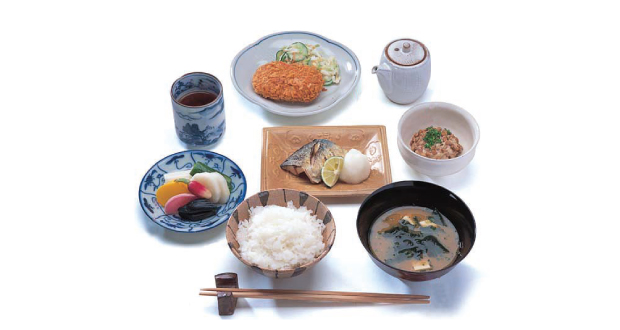
When vegetables are pickled they
keep longer than when raw, and they have extra nutritional value because of the
lactic acid bacteria that grow as part of the fermentation process. Each part
of Japan favors its own combination of vegetables and seasonings to make tsukemono.
The photo to the left shows three types: clockwise from left, daikon radish
pickled in vinegar, beets pickled in sweet vinegar, and cucumber pickled in soy
sauce.
Above middle: Vegetables pickled
in a salted rice bran paste.
Above right top: Eggplant,
cucumber, and turnip pickled in miso paste.
Above right bottom: If the
vegetables are pickled for too long, you can remove some of the salt by
chopping them up fine and soaking them in water before eating.
French croquettes became a
Japanese “Western” dish. In Japan croquettes are generally served with rice and
come with a shredded raw cabbage salad.
Mashed potato with ground meat
and minced onion added. The mixture is patted into easy-to-handle oval shapes,
coated with breadcrumbs then deep-fried. The Japanese word korokke comes from
the French, croquette.
It would be hard to imagine
Japanese cuisine without shoyu (soy sauce). It is such an easy-to-use
seasoning, ideal for soups and broths, simmered foods and a full range of other
dishes. It sits on the table until someone grabs it to sprinkle directly on
food. To make it, first of all soybeans, wheat and salt are added to water.
Brine and a fermenting agent (a koji mold cultivated on soybeans and wheat) are
then mixed in. After the resulting mash, known as moromi, ferments for several
months, it is squeezed through a cloth to obtain as much of the liquid as
possible. The liquid is heated to kill bacteria, and the final result is soy
sauce.
There are three main types of soy
sauce:
* koi-kuchi, with a dark color
and a rich taste
* usu-kuchi, with a lighter color
and taste
* tamari, with a higher
concentration of soybean and less salt.
Most people buy the first type,
so that today the word koi-kuchi is practically synonymous with soy sauce.
Usu-kuchi sauce is given a lighter color so that it will not discolor simmered
foods and other ingredients.
Tradition says that a Zen priest
went to China in the 13th century and brought back the technique for making
kinzanji miso. A liquid seeping out of vegetables pickled in this miso was a
kind of soy sauce, and this, it is said, was the beginning of tamari, the third
variety of soy sauce. Beginning in the 1500s, it was produced mainly in the
Kyoto and Osaka region, but after the mid-1600s the population of Edo
(present-day Tokyo) mushroomed and the main center of production shifted to an
area just east of Edo, in what is now Chiba Prefecture. The older tamari
manufacturing process, which produces a milder sauce, evolved to yield
koi-kuchi, the dark-colored, salty sauce preferred by the people of Edo.
Chiba Prefecture remains Japan’s
most important production center for soy sauce, even today. Miya Shoyu-ten is
the only maker in Chiba that follows the old brewing process. Its soy sauce is
sold under the trade name, Tamasa.
Miya Keiichiro, the company’s
managing director, says, “When we make soy sauce, we aim for an excellent
balance of fine fragrance and mild taste. When it comes out just right I feel
glad I’m continuing my family’s manufacturing traditions. I still have years to
go before I can be proud of my record, though.” He has been managing his
ancestors’ business, which goes back 170 years, for 12 years so far. Miya’s
goal is to achieve the best possible taste, so he uses traditional brewing
methods that take advantage of natural changes in temperature. His company
could change over to mass production, but that is not his ambition—he is after
a superior taste. That means, of course, starting with the best ingredients.
“Our soybeans and wheat come from
this prefecture. The water is ideal, from our own spring-fed well. We get the
salt from Mexico, because of its higher amino acid content.” Miya is on to
something, because many chefs prefer his variety of soy sauce. Miya Shoyu-ten’s
Japanese-language website: http://www.miyashoyu.co.jp/3
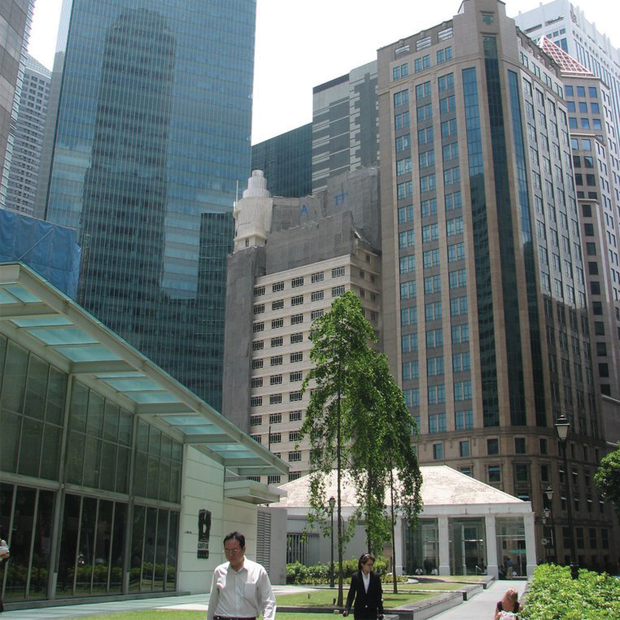
AIA Singapore announced today that it has agreed with HSBC
Insurance (Singapore) to make an offer to the agents of HSBC Insurance
(Singapore) to join AIA.
This opportunity for HSBC Insurance (Singapore)’s agents is
the result of HSBC Insurance (Singapore)’s decision to focus on its insurance
manufacturing and bancassurance operations and is expected to further extend
AIA’s market-leading agency force in Singapore. Those agents who choose to take
up the offer will be subject to the normal relevant regulatory approvals before
joining AIA.
Mr. Tan Hak Leh, Chief Executive Officer, AIA Singapore,
said, “We are delighted to be able to offer HSBC Insurance (Singapore)’s agents
an opportunity to continue – and advance – their careers in the dynamic
Singapore insurance market. This offer will also provide the customers of these
agents with the option to receive continuity of service. AIA’s Premier Agency
distribution capability together with our product innovation, financial
strength and leading brand position are key competitive advantages for AIA that
will ensure we continue to be a market-leader in Singapore.”
About the AIA Group
AIA Group Limited and its subsidiaries (collectively “AIA”
or “the Group”) comprise the largest independent publicly listed pan-Asian life
insurance group. It has operations in 17 markets in Asia-Pacific – wholly-owned
branches and subsidiaries in Hong Kong, Thailand, Singapore, Malaysia, China,
Korea, the Philippines, Australia, Indonesia, Taiwan, Vietnam, New Zealand,
Macau, Brunei, a 97 per cent subsidiary in Sri Lanka, a 26 per cent joint
venture in India and a representative office in Myanmar.
The business that is now AIA was first established in
Shanghai over 90 years ago. It is a market leader in the Asia-Pacific region
(ex-Japan) based on life insurance premiums and holds leading positions across
the majority of its markets. It had total assets of US$147 billion as of 31 May
2013.
AIA meets the savings and protection needs of individuals by
offering a range of products and services including retirement savings plans, life
insurance and accident and health insurance. The Group also provides employee
benefits, credit life and pension services to corporate clients. Through an
extensive network of agents and employees across Asia-Pacific, AIA serves the
holders of more than 27 million individual policies and over 16 million
participating members of group insurance schemes.
AIA Group Limited is listed on the Main Board of The Stock
Exchange of Hong Kong Limited under the stock code “1299” with American
Depositary Receipts (Level 1) traded on the over-the-counter market (ticker
symbol: “AAGIY”).
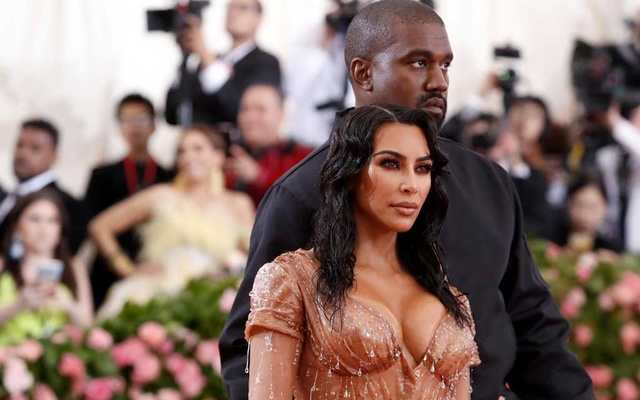
Reality television star Kim Kardashian announced on Friday she has named her fourth child, a boy born last week via a surrogate, Psalm West.
Kardashian wrote “Psalm West” in a post to her 60 million followers on Twitter that included a photo of the infant wrapped in a blanket in a crib with a caption that read in part: “We are blessed beyond measure. We have everything we need.”
Kardashian and her musician husband Kanye West have three other children – Chicago, a girl who was also born via a surrogate in January 2018, a son, Saint, 3, and daughter North, 5.
Kardashian has said she decided to use a surrogate after doctors warned of serious health risks if she became pregnant again following the birth of Saint in 2015.